
Post-Prostatectomy Incontinence
Urinary Incontinence is the involuntary loss of urine. In men urinary incontinence is most common after prostate removal surgery (radical prostatectomy) for prostate cancer.This page will focus mainly on stress incontinence after prostate surgery.
Men may have incontinence from other causes. Neurologic disease such as stroke or Parkinson’s Disease, injury to the pelvis or urethra, bladder failure from diabetes or overstretching of the bladder are other possible reasons for urinary incontinence. These conditions often require a combination of treatments that may require a surgical option.
What is Stress Incontinence after Prostate Surgery?
Stress incontinence can happen after prostate surgery or prostate cancer treatment. After prostate cancer surgery, a weakened urinary sphincter muscle, poor coaptation (closing) of the urethral mucosa, or changes in the angle and effective urethral length where the bladder and the urethra meet can all contribute to stress urinary incontinence.
Patients with stress urinary incontinence (SUI) notice leakage when they are coughing, lifting heavy objects, and/or performing strenuous activities.
Treatment for stress incontinence depends on the degree of incontinence, i.e. how much leakage is occurring. The way we determine the severity of the leakage is by how many pads or diapers a man is using to stay dry during a day. Using a daily pad or a pad “just in case” is considered low volume leakage. Using more than one pad daily up to 3-4 pads is considered moderate leakage. Men using 4 or more pads daily have heavy leakage. These are broad definitions but serve as a guideline for discussion of treatment options.
What Options Exist for Treating Stress Incontinence?
There are two surgical options that have the highest chance of success. Other options exist, but I would consider them experimental.
Men choosing a surgical procedure will need to decide on an Artificial Urinary Sphincter (AUS) or a male sling (Advance XP is then one I use most commonly).
The AUS is the more common procedure and is more often the appropriate choice. Men with the largest amount of leakage need an Artificial Urinary Sphincter (AUS). Men who have received radiation for treatment of their prostate cancer also need to have an artificial urinary sphincter placed. Men with moderate amounts of leakage who have not received radiation and who can control their urinary sphincter (e.g. start and stop the flow of urine when urinating) are candidates for a sling procedure.
Choosing to proceed with any further surgery can be difficult. Most men are wary of any further surgery after having the complication of urinary incontinence. The good news is that the procedures do have high rates of success and satisfaction for those men who choose the operations.
The information here is intended to help you make a decision about the procedures as well as give you resources for alternative methods of treatment.
The AUA has published guidelines on this subject.
(INCONTINENCE AFTER PROSTATE TREATMENT:AUA/GURS/SUFU GUIDELINE 2019; Amended 2024)
Artificial Urinary Sphincter
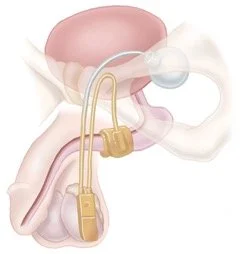
The AUS is the more common procedure and is more often the appropriate choice. Men with the largest amount of leakage need an Artificial Urinary Sphincter (AUS). Men who have received radiation for treatment of their prostate cancer also need to have an artificial urinary sphincter placed. .
Advance XP Male Sling
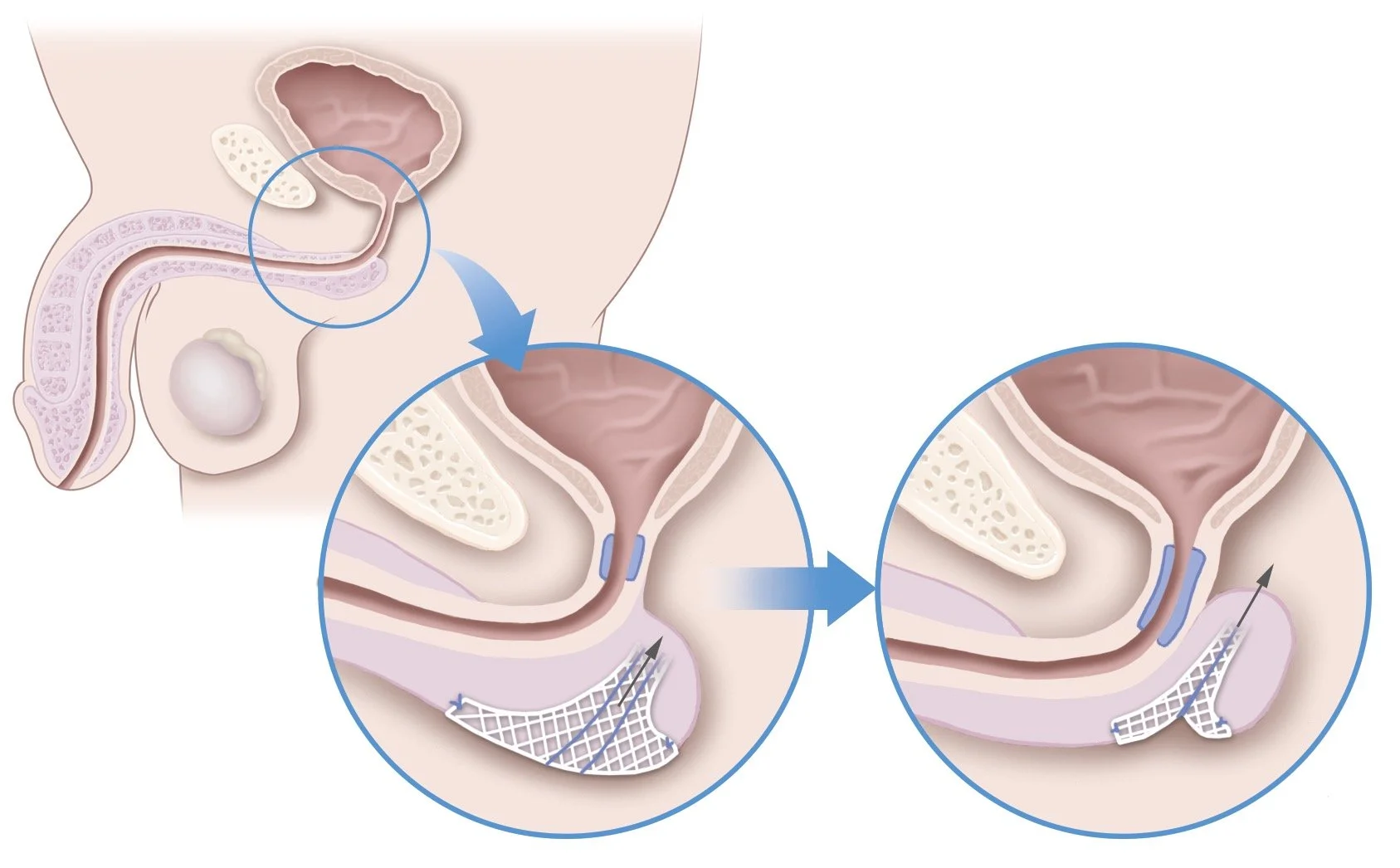
Men with moderate amounts of leakage who have not received radiation and who can control their urinary sphincter (e.g. start and stop the flow of urine when urinating) are candidates for a sling procedure.
Artificial Urinary Sphincter
The artificial urinary sphincter is used for men with the most severe levels of incontinence or men who have been treated with radiation therapy. The artificial sphincter is safe and effective.
Pictured here is the AMS 800 Artificial Urinary Sphincter. The three components are the pressure balloon, the sphincter cuff, and the sphincter pump
The concept of how an artificial urinary sphincter works may be difficult to understand at first, but the principles here are actually quite simple. The whole system is pressurized by the pressure regulating balloon. This pressure fills the sphincter cuff which closes on the urethra. When a man needs to urinate he squeezes the pump that is in the scrotum, transferring fluid out of the cuff. The cuff opens, allowing him to void. The cuff then slowly fills on its own by the pressure from the pressure regulating balloon. The short video here explains how this work along with an animation.
Advance XP Male Sling
The Advance Male Sling is used for men with less severe levels of incontinence. Although not a consistently effective as an artificial urinary sphincter, a male sling has the advantage of not being a mechanical device.
Pictured here is the Advance sling cartoon. The picture depicts the compression of the urethra by the sling when tensioned. The sling works by compressing the intra-sphincteric urethra.