Hematuria
Blood in the urine is common. but it is not considered normal. Blood in the urine almost always deserves a full evaluation. Blood in the urine is called hematuria.
Blood may be visible to you. This is called gross hematuria (because it is grossly visible, not because it is gross). It will appear red, pink or rust colored. There can be clotting or flecks of red blood. You may see blood only one time or there may be repeat episodes. Any of these indicate there may be a problem. Gross hematuria always requires evaluation. A full evaluation of gross hematuria most often includes a cystoscopy, kidney imaging such as CT scan, and urine testing for infection and possibly cytology or FISH testing.
The blood may only be visible under a microscope (called, for obvious reasons, microscopic hematuria). The critical element for diagnosing microscopic hematuria is actually seeing red blood cells under a microscope. Microscopic hematuria can indicate just as serious of a problem as gross hematuria. That is worth repeating. Microscopic hematuria can indicate just as serious a problem as gross hematuria. Microscopic hematuria requires a similar evaluation in most cases with a cystoscopy, CT or Ultrasound, and possibly urine cytology or other urine testing. Some patients have low risk microhematuria that does not require invasive testing.
Common problems causing blood in the urine include infections, kidney stones, and cancers such as bladder or kidney cancer. The list of possibilities is long. The most concerning findings are when we find cancer or a stone that is actively causing a problem.
Blood in the urine may not reveal any problems at all. You may have blood in the urine without ever having any problem develop because of it. Many of the evaluations we do for blood in the urine, particularly microscopic hematuria, do not find any specific pathology that requires repair or correction.
Grades of Gross Hematuria
pale, pink
brown
cherry
Kool-Aid
peach
pink lemonade
Blood in the urine can appear in multiple different shapes. Even the pale, pink at the far left is considered gross hematuria and requires evaluation
Guidelines and Algorithms
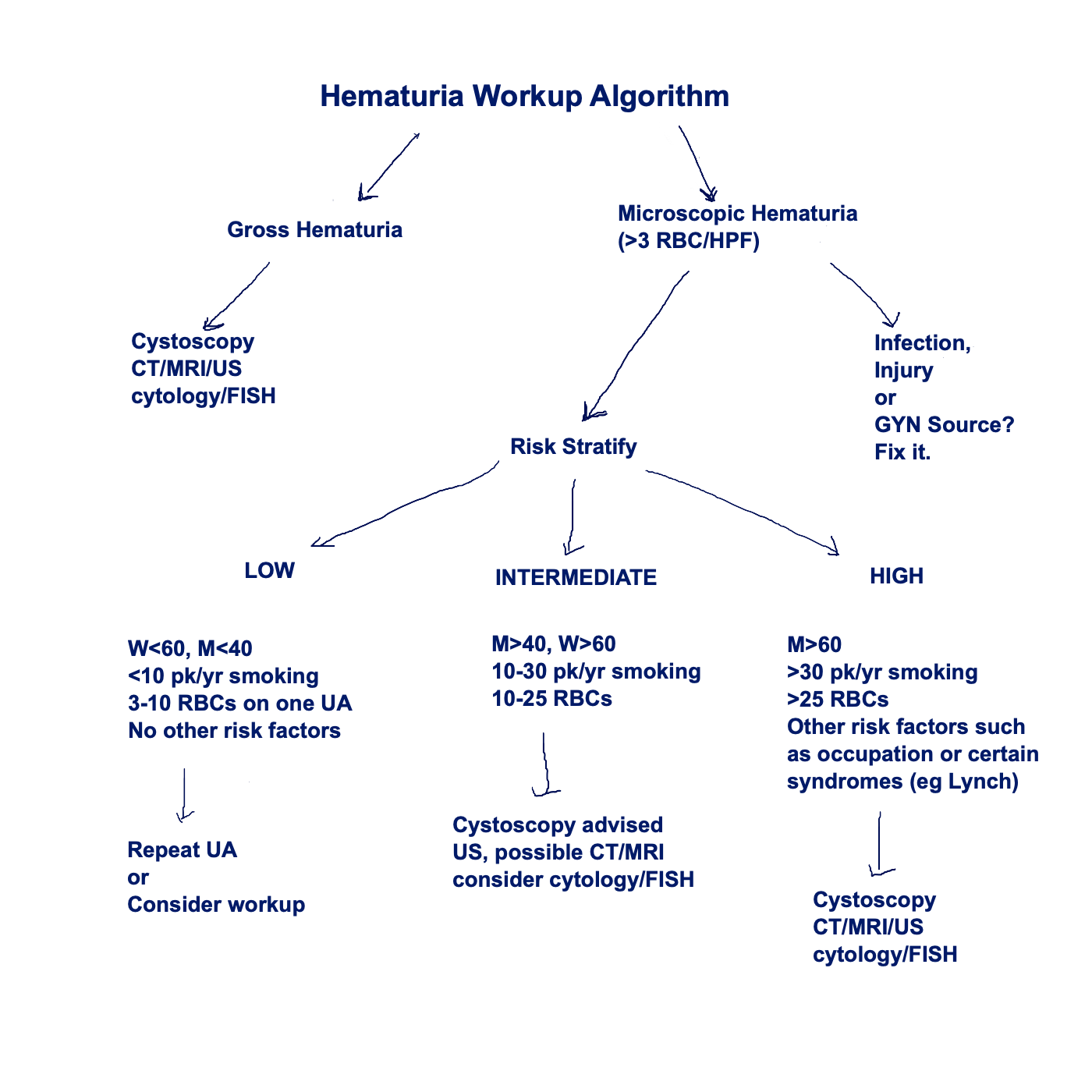
Algorithms help physicians make decisions. Pictured here is my reworking of the AUA Guidelines Algorithm on the workup of microhematuria.
The evaluation includes evaluation of the bladder, specifically a cystoscopy and evaluation of the kidneys and ureters if needed.
Gross hematuria almost always needs evaluation. A full workup includes cystoscopy and a CT Urogram with contrast and urinary studies including a cytology and possible FISH studies.
Microscopic hematuria can be risk stratified in the ways listed in the algorithm. Caution is required. Even low risk patients can have bad disease.
Followup on the micro or gross hematuria is critical to find conditions not originally diagnosed. Small tumors, stones, or problems can grow over time and may be detected some time in the future. Your ongoing workup needs will be determined by a discussion with your primary physician or urologist.
CLICK HERE to view the AUA guidelines for workup on microhematuria